
Urban Digital Twin for Calgary
This project is a collaboration between the City of Calgary and the University of Calgary, aimed at exploring how digital twin technology can support urban planning, management, and decision-making in Calgary’s context.
Research and Scoping
The first phase focused on a comprehensive review of both academic and grey literature to establish a clear understanding of city digital twins—their definitions, characteristics, and potential applications. Key areas of investigation included:
- Definitions and core characteristics of digital twins, with emphasis on urban-scale implementations
- Maturity models for digital twins and city digital twins
- Case studies of real-world city digital twin initiatives, both successful and unsuccessful, and the lessons learned
- Business models, ROI, and governance considerations
- Technological frameworks and architectures relevant to urban digital twins
- A survey of companies and vendors active in this domain
- Identification of technical and non-technical challenges expected in developing and maintaining city digital twins
The findings were consolidated in a detailed internal report for the City of Calgary, accompanied by a presentation summarizing insights and recommendations.
Ongoing Prototype Development
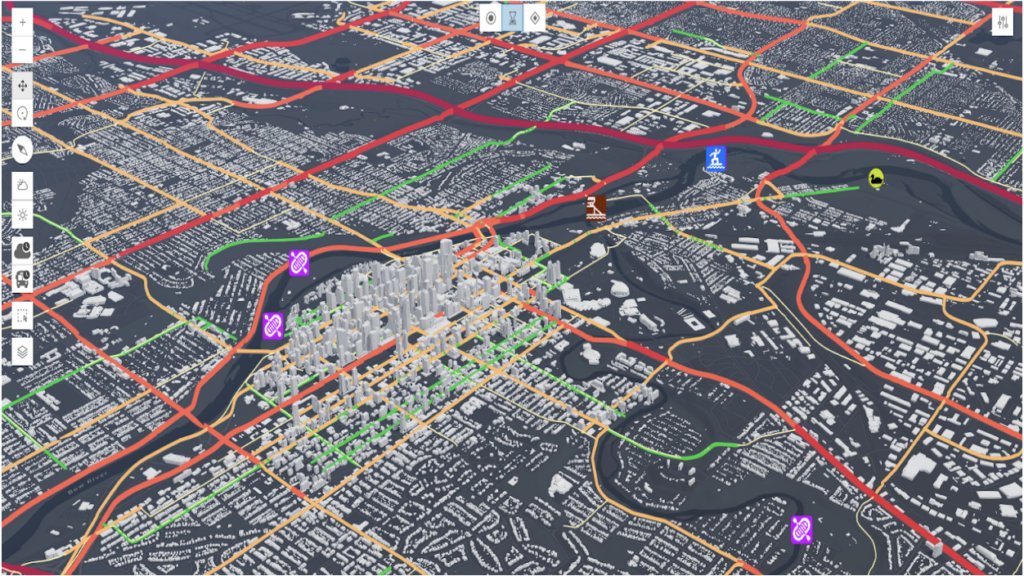
Building on this research, the team began developing a prototype urban digital twin for Calgary. We started with creating a functional proof of concept that could visualize and interact with real city data. The prototype integrates several of Calgary’s public datasets — including map data and live feeds such as public transit— into an interactive web application. The current version serves as a working foundation for more advanced features, including enhanced data integration, analytics, and simulations. This project is ongoing, with continued development of the prototype to expand its capabilities.